The Definitive Guide to Mastering the Perfect Chicken Breast
The chicken breast is perhaps the most versatile and essential protein in the modern culinary repertoire. Revered for its high protein content and low fat density, it serves as a blank canvas for flavors spanning every global cuisine. However, its greatest strength—its leanness—is also its greatest challenge. Without the insulating fat found in thighs or wings, the chicken breast is notoriously susceptible to overcooking, often resulting in a dry, unappealing texture. Mastering this cut requires an understanding of heat management, moisture retention, and the science of protein denaturation.
The Anatomy of Flavor: Why Technique Matters
To achieve the succulent, golden-brown results seen in professional culinary photography, one must balance two competing goals: creating a flavorful, seared exterior and maintaining a juicy, tender interior. The chicken breast consists of lean muscle fibers that begin to contract and expel moisture once they exceed $150^\circ\text{F}$. By the time a breast reaches the traditionally recommended $165^\circ\text{F}$, it has lost a significant percentage of its weight in water.
Modern culinary science suggests that for a chicken breast to remain juicy, it should be removed from the heat at $160^\circ\text{F}$, allowing “carryover cooking” to bring it to the final safe temperature while it rests. This resting period is non-negotiable; it allows the internal juices to redistribute, ensuring they stay within the meat rather than spilling onto the cutting board.
1. Pan-Seared Garlic and Herb Chicken Breast
This recipe focuses on the classic stovetop method, utilizing a heavy-bottomed skillet to achieve a mahogany crust and an aromatic butter baste to infuse the meat with moisture.
Ingredients
- Protein: 2 large boneless, skinless chicken breasts (approximately 8–10 oz each).
- Fats: 2 tbsp avocado oil (high smoke point) and 3 tbsp unsalted butter.
- Aromatics: 4 cloves of garlic (crushed), 3 sprigs of fresh thyme, and 1 sprig of fresh rosemary.
- Seasoning: 1 tsp kosher salt and ½ tsp freshly cracked black pepper.
Preparation Method
- Preparation: Pat the chicken breasts bone-dry with paper towels. This is the single most important step for achieving a proper sear; moisture on the surface creates steam, which prevents browning.
- Seasoning: Season aggressively on all sides with salt and pepper.
- The Sear: Heat a cast-iron skillet over medium-high heat until the oil just begins to shimmer. Lay the breasts in the pan, curved side down. Sear undisturbed for 5–6 minutes.
- The Flip and Baste: Flip the breasts. Lower the heat to medium and add the butter, garlic, and herbs. As the butter foams, tilt the pan and spoon the hot, infused fat over the chicken repeatedly for the final 4–5 minutes.
- Resting: Remove the chicken when the internal temperature hits $160^\circ\text{F}$. Let it rest on a wooden board for 8 minutes before slicing.
2. Oven-Roasted Lemon-Garlic Chicken Breast
Baking or roasting is the preferred method for those seeking a “set it and forget it” approach that still delivers premium results. The key here is high heat and the addition of citrus to cut through the density of the meat.
Ingredients
- Protein: 4 boneless, skinless chicken breasts.
- Liquid Base: ¼ cup extra virgin olive oil and the juice of 1 large lemon.
- Aromatics: 1 tbsp minced garlic and 1 tsp dried oregano.
- Finishing: Freshly chopped parsley and lemon slices.
Preparation Method
- Preheat: Set your oven to $425^\circ\text{F}$ ($220^\circ\text{C}$). High heat ensures the exterior browns before the interior can dry out.
- Marinate: Whisk the oil, lemon juice, garlic, and oregano. Toss the chicken in this mixture and let sit for 15 minutes.
- Roast: Place the chicken in a baking dish. Pour the remaining marinade over the top and nestle lemon slices between the breasts.
- Timing: Bake for 18–22 minutes depending on thickness.
- The Finish: Garnish with parsley. The pan juices are liquid gold; pour them back over the sliced meat before serving.
3. The Science of the Brine: An Essential Hack
For those who struggle with dry chicken, “dry brining” is a revolutionary technique. By salting the chicken 30 minutes to 24 hours before cooking, you change the structure of the muscle fibers. The salt dissolves some of the proteins, allowing the meat to hold onto more water during the cooking process.
Pro Tip: If using a wet brine (salt dissolved in water), ensure the chicken is dried thoroughly before it hits the pan, or you will lose the ability to create a crust.
4. Mediterranean-Inspired Sliced Chicken Platter
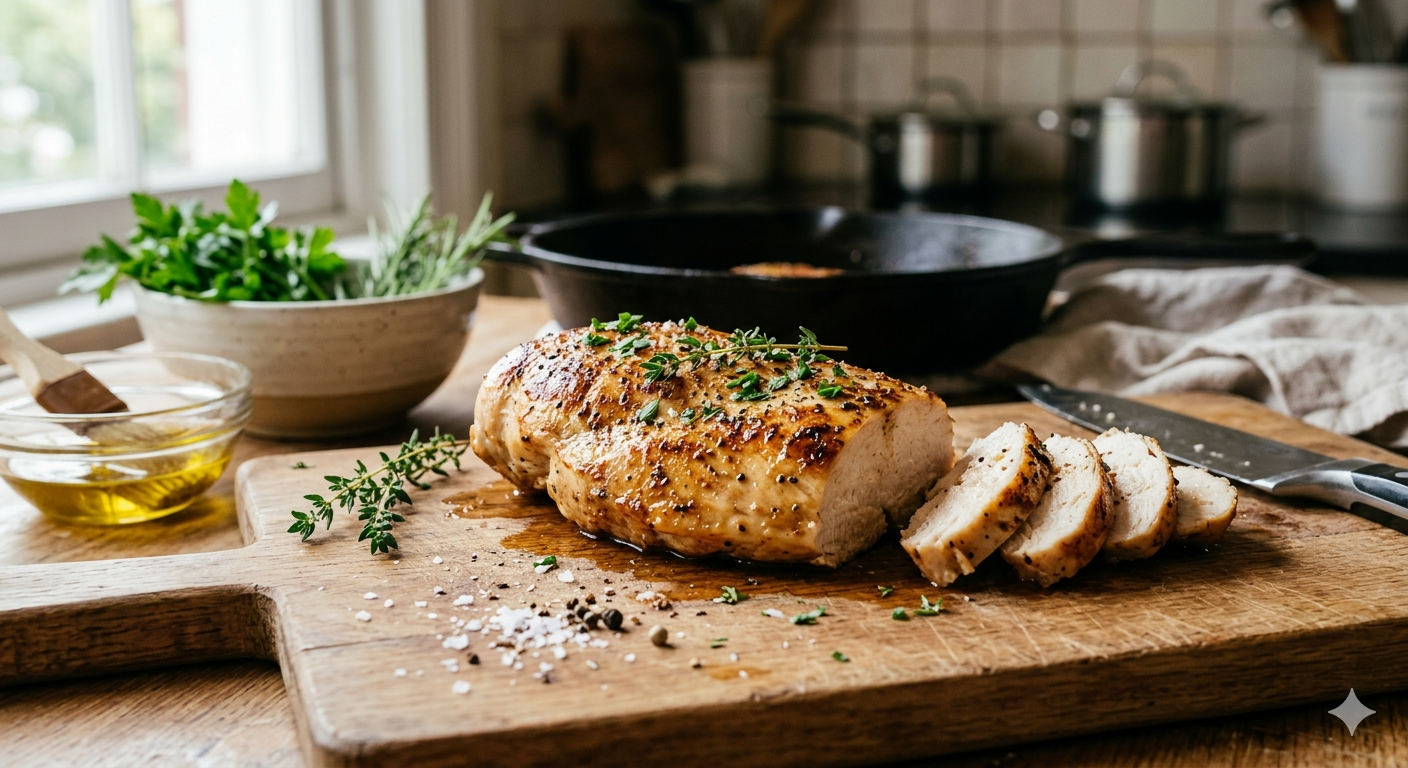
As showcased in the professional culinary setup, presentation and accompaniment play a vital role in the dining experience. A perfectly cooked breast is elevated when paired with fresh, vibrant elements.
The Component List
- The Sliced Chicken: Follow the Pan-Seared method above, ensuring a deep brown crust.
- The Herbed Oil: A small bowl of extra virgin olive oil infused with fresh thyme and rosemary for drizzling.
- The Finishing Salt: Flaky sea salt (like Maldon) added just before serving to provide a textural pop.
- The Side: Fresh flat-leaf parsley and rosemary sprigs to provide a refreshing aromatic contrast.
Technical Troubleshooting
- Uneven Thickness: Chicken breasts are naturally tapered. This causes the thin end to overcook while the thick end remains raw. The Solution: Use a meat mallet to pound the thickest part of the breast until the entire piece is a uniform ¾-inch thickness.
- Sticking to the Pan: If the meat won’t release from the skillet, it isn’t ready to be flipped. The meat will naturally “release” once the Maillard reaction has sufficiently hardened the exterior.
- Rubbery Texture: This is often the result of “woody breast,” a condition found in some over-sized, commercially raised poultry. To avoid this, select air-chilled, organic, or pasture-raised chicken whenever possible, as these birds tend to have superior muscle fiber structure.
Nutritional Profile
A standard 6 oz serving of cooked chicken breast provides approximately:
- Calories: 280 kcal
- Protein: 52g
- Total Fat: 6g
- Saturated Fat: 1.5g
- Carbohydrates: 0g
This makes it an unparalleled choice for weight management and muscle recovery. By mastering the techniques of pan-searing and roasting, you ensure that this dietary staple is never a chore to eat, but rather a highlight of your culinary week.